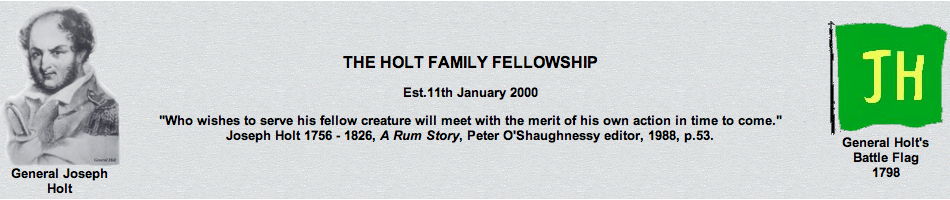
THE HOLT FAMILY FELLOWSHIP
Est.11th January 2000
"Who wishes to serve his fellow creature will meet with the merit of his own action in time to come."
Joseph Holt 1756 - 1826, A Rum Story, Peter O'Shaughnessy editor, 1988, p.53.
| About Us | About Joseph | Noticeboard/Home | Contact The Fellowship |
| The General's Chat Room | United Irish Researchers Chat | Ascendancy & Yeomen Researchers' Chat |
ALL ARTICLES APPEARING ON THE 'www.joseph-holt.org' WEBSITE ARE SUBJECT TO COPYRIGHT.
About Joseph
General Joseph Holt was the only United Irish General to be banished to New South Wales following his surrender in County Wicklow during the 1798 Irish Rebellion. The Bank of Ireland director, Peter La Touche and his wife, Elizabeth La Touche, as members of the Ascendancy, apparently helped orchestrate Joseph's safe surrender to Lord Powerscourt IV at 11 O'Clock on the 11th November 1798 at his demesne of, Powescurt, in County Wicklow. Captain Salkeld's new ship, Minerva, embarked the political prisoner, Joseph, who had to pay passage for his wife, Hester, and elder son, Joshua who were to accompany him. Hester Holt's sister was an employee of Elizabeth La Touche. Elizabeth had her pay the passage and cover the expense of the cabin that Joseph had to build on deck to house them. This was a normal custom of the time. He also had to supply victuals for them for the long voyage.In addition, it housed the wife and children of his friend and fellow United Irishman, Reverend John Fulton. Joseph Harrison Holt was born aboard during their six months wait in Kingstown (Cobh of Cork) before the Minerva sailed on the 24th August 1799 as a member of the convoy to Port Jackson (Sydney), New South Wales. It had a crew of 28, including Captain Salkeld.
Apart from the 4 members of the Holt family, it carried 34 women and 132 male prisoners, mainly United Irish convicts. The 32 members of the accompanying N.S.W. Corps were under the command of Lieutenant William Cox of Dorset who, in addition, was accompanied by his wife, Rebecca, and four sons, Charles, George, Henry and Edward. As with Joseph Harrison Holt, Francis Edmund Cox was born on board as they waited for the convoy to sail. Their eldest son, William, and previously youngest son, James, remained behind to finish off their education at King Edward VI Grammar School, Salisbury, William Cox's former school.
Because of the strain placed on his new ship through the need to hold it back to keep pace with the slower convoy, Captain Salkeld was given permission to leave the convoy behind and sail independently. The Minerva, created a then world record by taking only 4 months, 17 days, from August 24 1799 to January 10, 1800, to reach Port Jackson from the Cobh of Cork via Rio de Janeiro and Cape Horn using the Trade Winds. During the voyage, Joseph and his family were befriended by Lieutenant William Cox and his family. Hester Holt and Rebecca Cox shared their motherhood on board and would have had many a conversation during their long voyage. With their husbands already learning to respect each other's qualities, it was the start of a family friendship which has endured throughout each subsequent generation to this day since its commencement in 1799.
Joseph's father, Joseph John Holt. of Ballydonnell, a farmer and builder, apprenticed his other sons into the building trades. In 1773, as Joseph was interested in farming, he encouraged his desire by having him work for his friend, John Low, the steward and gardener for Mr Sweeney, at his property near Bray, Co. Dublin. After 5 & 1/2 years there, he left for the North to gain further experience. Upon his return, Joseph was met in Phoenix Park, Dublin, by Captain Fitzgerald, a family friend, who offered him the position of Paymaster Sergeant of his 32nd Regiment of Foot provided that he recruited 32 men for the East India Company. He accomplished this in 1788 and stayed with them until his parents requested that he come home. He then left the regiment and remained two years with his parents until his marriage to Hester Manning in 1780.
From their many discussions on board the Minerva, William Cox realised that Joseph's agricultural knowledge and experience:would be advantageous for him in New South Wales. When Joseph stepped ashore on the 11th January 1800, William immediately sought Joseph's advice for his land purchases and appointed him his farm manager. They commenced with the purchase of Captain John Macarthur's, 100 acres, The Brush, then the departing Reverend Mr Richard Johnson's 460 acres farm, Canterbury (Memoirs of Joseph Holt, General of the Irish Rebels, T. Crofton Croker editor, 1838; Land Grants, 1788-1809, R. J. Ryan, 1981; Canterbury Farm - 200 years, B. Madden & L. Muir, 1981; op cit, P. O'Shaughnessy editor, 1988, Looking for Joseph, P. Goesch, 2008).
Joseph set about enlarging, The Brush, by acquiring the adjacent farms on William's behalf. The Brush Farm Estate had grown to 455 acres from the original 100 acres when it was sold by Captain William Cox to Gregory Blaxand to cover the unexpected sudden calls on his promissory notes commenced by his former friend, Sir John Jamison, following an argument in Sydney during February 1803. The original homestead is not extant.
When Governor Bligh was deposed, Major Abbott arranged for Joseph to be pardoned by Lieutenant-Governor Colonel Paterson on the 6th June 1809. A few weeks later, he also arranged for the Colonel to grant 110 acres each to Joseph and his son, Joshua. The area was surveyed by the acting surveyor, the United Irishman, John Meehan. Joseph's grant was adjacent to Joshua's and the Thirteen Thousand acres of Common.
With further grants to other United Irishmen, such as Michael Dwyer, Arthur Devlin, Martin Burke, Hugh Byrne and John Mernagh on Cabramatta Creek in May 1809, the area soon became known as Irish Town, now Mt Pritchard (op.cit. P. Goesch). When Governor Macquarie subsequently confirmed Joseph's pardon and the two grants of land to his family, he was allowed to sell his grant which he had called, Holt's Fancy, to Martin Short from County Kildare. He then sold his purchased convict George Tilley grant, which he had renamed, Glen Bride Estate, to Mr Edward Lord, who is remembered today as a successful Sydney leader of commerce. It was near William Cox's Brush Farm.
He sold his livestock, poultry, grain, corn crop and farm equipment to the leading men of the day. Upon the sale of his previously purchased, Mt Hester Estate, named after his wife. Joseph then removed to Sergeant Major's Row in Sydney with Hester and youngest son, Joseph Harrison Holt, to await passage to Ireland. His sales totalled over One Thousand Eight Hundred Pounds Sterling which he later invested in a public house in Dublin. He was subject to a great deal of animosity there from patrons who believed that he had turned informer in 1799. He sold his public house and invested in tenement houses in York Road, Kingston (Dun Laoghaire) where he lived off his rents in number 72 until his death in 1826.
Portion of the Mt Hester Estate is now part of The Kings' School at Parramatta. Lake Parramatta Reserve contains his, 'Rocks of Jerusalem', where he illicitly distilled his peach brandy and had hidden his still, (Memoirs of Joseph Holt, General of the Irish Rebels, in 1798, p. 273, T. Crofton Croker, editor; A Rum Story, p. 102, 1988, Peter O'Shaughnessy; Looking for Joseph, p.4, Pamela Goesch, 2008). In December 1812, he took passage in the Isabella, with Hester and Joseph Harrison Holt bound for Liverpool and their daughter Mary Anne in Dublin, leaving the married Joshua with his wife, Elizabeth Holt nee Bray, to go on to fame and fortune. Little did they realise what lay ahead for them.
Despite an unblemished record with the British East India Company, Captain Richard Brooks earned the censure of Governor Philip Gidley King in 1802 for the ill-health and high death rate amongst the convicts aboard the 452 ton convict transport, Atlas under his command to Sydney, reportedly from overcrowding due to his huge personal cargo. He subsequently commanded the Alexander in 1806; then the trading vessels, Rose, 1808; Simon Cock, 1810; and the Argo in 1811, on their voyages to New South Wales from England. (A.D.B. Vol 1, M.U.P.,1966, Vivienne Parsons). He was thus well versed in the vagaries of the icy storms of Cape Horn. The passengers and crew were lucky that this ship's master was returning to England as a passenger on board the Isabella. The Isabella departed Port Jackson on the 5th December 1812. Captain Richard Brooks found it necessary to chastise the Isabella's master, Captain George Hicton, and his crew for their shoddy seamanship and took over temporary command as they rounded Cape Horn.
Captain Hicton was drunk as they neared the Falkland Islands (Malvinas). During a heavy storm, the Isabella was blown off course and wrecked on Eagle (Speedwell) Island having safely negotiated its passage between New Island and Steeple Jason Island. "Captain Brooks was on deck all the time and God and him was our protectors. When she lost her rudder he made them square the yards and run for the land and, as it was the will of God, she run in between two rocks and her bowsprit was over dry land." (op. cit., Peter O'Shaughnessy, 1988). Joseph then joined Captains Brooks and Durie to form a shipwreck management committee with others. Sir Henry Browne Hayes joined the drunken faction of sailors and marines who helped themselves to the ship's alcohol cargo. The majority of personnel were subsequently rescued.
Joseph, Hester and Joshua arrived in a sailing packet from Liverpool at the Pigeon House in Dublin Bay on the Fifth Day of April 1814 after sailing in convoy from Rio de Janeiro on October 23, 1813 to there in the brig, Venerable.
Captain Brooks also returned to England before sailing back to New South Wales in the, Spring, with his wife and children in 1814. Governor Macquarie granted him land in Cockle Bay (Darling Harbour), where he set up as a ships chandler. Upon his success, a further 300 acres in the Illawarra region was also granted. He went on to become a prominent early settler who supported religious charities of all denominations, possibly as a result of his past experiences. A member of the New South Wales Agricultural Society, he was gored in the thigh by a wild cow when on horseback at Denham Court (near Ingleburn) a property he obtained from Judge Richard Atkins in a debt settlement. He died on October 16, 1833. "He was buried in a vault at Denham Court and the Church of St Mary the Virgin was built to enclose their remains." (op.cit., Vivienne Parsons). His wife, Christiana nee Passmore, died on April 12, 1835.
Editorial: Joseph, 1798 and The Aftermath.
Joseph's 1798 battle successes at Balleyellis, Aughrim and the Hills of Glenmalure in South Leinster came from his ability to surmount most of his problems and unite his men in an effort to obtain freedom from Britain for an United Ireland. His charisma and determined military prowess attracted many to his banner. Even the Ancient Briton Captain, James Kelly, who escaped from the Battle of Balleyellis when his piked horse leapt over Joseph's carts' barrier, recognised that the United Irishmen were fighting for Ireland's independence and subsequently joined Joseph's army, (Memoirs of Joseph Holt General of the Irish Rebels in 1798, Vol. I, P. 92, T. Crofton Croker, editor, 1838; Rebellion in Wicklow General Joseph Holt's Personal Account of 1798, p. 45, Peter O'Shaughnessy, 1998; Rebellion in Wicklow 1798, p.392, Dr Ruan O'Donnell). As well as such members of the regular army, he also attracted yeomen deserters and certain of the professional Hessian troops to join his Wicklow men for the United Irish cause. He then took his opportunity to make full use of the Hessian deserters' military training by having them drill his inexperienced volunteers to prepare them for battle.The authorities took care to politically manipulate the factions so that a common purpose amongst the members of the Church of Ireland, Ascendancy, United Irish, Orangemen, Roman Catholic Church, Defenders, Dissenters and other Protestants could never be achieved.
Joseph's efforts for an United Ireland were lampooned, particularly following his surrender. Criticism of him is rife to this day. Fr Kavanagh's 1870's book purposely down-played the original Protestant Church of Ireland United Irish leaders' initiation of the 'Rebellion'. It is interesting to note that the military doyen of the Roman Catholic Byrne's family, Myles Byrne, had praised the Church of Ireland Joseph years before in his, Myles Byrne's Memoirs, published after his retirement from Napoleon's Grand Army. These memoirs include their exploits together against the combined British forces as United Irish Colonels and those following the Protestant Joseph Holt's "appointment in the field" to replace the Roman Catholic General Edward Roche as facilitated by his brother, Father Philip Roche as the Commander-in Chief. Together with General Edward Roche's men, his army apparently totalled 12,600 men. After these Vinegar Hill remnants joined him, he proudly stated, "I was the only Protestant Irish General in charge of 10,000 Roman Catholic soldiers."
It is a matter of record that Joseph was recognised internationally as an important Irish General. He dealt directly with both the revolutionary French Directory and subsequent Napoleon Bonaparte administration, hence his wearing of a French military officer's uniform as he awaited the French arrival. There is a contrast between the news from the contemporary French reporters to their Irish counterparts' reporting, as shown in 'Bien Informe, No. 405, 6 brumaire VII' (26 October 1798).
"Whenever Ireland was reported in newspapers it was to tell of the exploits of Joseph Holt, who became the symbol of Irish resistance." (The United Irishman, David Dickson, Daire Keogh & Kevin Whelan, p.266, 1994).
The use of quotes as in "General" Joseph Holt by authors, and/or editors, either shows a lack of knowledge or a desire to promote biased propaganda as in the newspapers of the day. The original editor of Joseph's memoirs in 1838, T. Crofton Croker, saw no need to use quotes despite his employ in the British Admiralty. If quotes are prompted because of the lack of qualifying troop numbers for Joseph to be considered a General, why are they not applied to his predecessor, the Roman Catholic General Edward Roche who obviously had less soldiers, or to certain Generals of the victorious armies in what has become the United States of America?
Joseph's adroit use of the Wicklow Mountains was vital to his successes. Joseph Holt became the most successful United Irish General of 1798, hence the perceived military need to ship him to the other end of the world where Napoleon's administration still managed to contact him in 1802 through the naval geographical explorer and cartographer, Thomas Baudin, who carried sealed dispatches to him (pers. comment, Dr Ruan O'Donnell). With more United Irish convicts in New South Wales than government troops, this recent knowledge could be the hidden reason for Governor Philip Gidley King's peremptory decision to have the successful United Irish General suddenly removed from court and, apparently illegally deported to the penal colony of Norfolk Island after the United Irish convict's Vinegar Hill uprising outside Parramatta, despite his protestations of innocence. It also could explain why Captain William Cox was powerless to help his friend.
Arriving in Norfolk Island, May 19, 1804, Joseph suffered severe, harsh treatment under Commandant Major Joseph Foveaux. It ceased before Foveaux was replaced as commandant by Captain John Piper thanks to the intervention of surgeon, Darcy Wentworth. Joseph was later sent back to Sydney in charge of the Norfolk Island government's and settlers' sheep and cattle aboard the Sydney, bound for Hobart in preparation for the closing of the Norfolk Island Penal Colony. They were disembarked on the 3rd December 1805 at Sullivan's Cove. Lt-Governor Collins was impressed as they were in better order and condition than those already present in Van Diemen's Land. This substantiated his knowledge of Joseph's abilities gained from Captain John Piper's dispatches received the day before. Seizing his opportunity, he requested Joseph to survey The Great River (Derwent) in the Lieutenant Governor's whale boat to find good agricultural land for the planned resettlement of the Norfolk Island population. The current city of New Norfolk, where most of Norfolk island's former settlers and harshly treated United Irish convicts were settled on the Derwent River, resulted from this exploration (Memoirs of Joseph Holt, General of the Irish Rebels, in 1798. Vol. II, T.Crofton Croker, editor, 1838, A Rum Story, Peter O'Shaughnessy, editor,1988; A History of New Norfolk and the Derwent Valley, K. R. von Steiglitz, O.B.E., 1961). The names of Joseph Holt and his 1805 Derwent River expedition companion, Denis McCarty, were included on the Memorial to Settlers in St David's Park, Hobart, unveiled by Queen Elizabeth in 1954. Amongst others, it honoured the arrival from Norfolk Island of the freemen, convicts, marines, sailors and soldiers. (Looking for Joseph, 2008, p.36, Pamela Goesch).
The reason given by the Vatican for their lack of support of the United Irishmen in 1798 and the Fenian's cause in 1867 was that these societies required a secret oath to be sworn. It still holds for the Masonic Lodge to this day.
Because of the mounting criticism of the Roman Catholic Church's official Ascendancy stance in both instances, they belatedly reversed this to reduce the criticism, by having Father Patrick Kavanagh write a biased 'Rebellion' history which was published, in 1870 as, A Popular History of the Insurrection of 1798. It demeaned the United Irish involvement, "riddled by spies, ruined by drink, with self important leaders...", (p. 170, The Tree of Liberty, Radicalism, Catholicism and the Construction of Irish Identity 1760 - 1830, Dr Kevin Whelan) and eulogised the previously denied 'renegade' active priest leaders of the '1798 Rebellion', such as, Frs. Mogue Kearns, John Murphy, Michael Murphy, Philip Roche, Thomas Clinch and others. The Roman Catholic Archbishop of Dublin, Dr John Thomas Troy (1786 - 1823) had then described these modern-day heroes as, "excommunicated priests, drunken and profligate couple-beggars, the very faeces of the church.", (A Vindication of the Roman Catholic clergy on the tour of Wexford during the late unhappy Rebellion, 1799, courtesy of David Flood, http://www.struggle.ws/andrew/1798.html).
Seventy two years after Archbishop Dr John Troy had excommunicated his insurgent young rebel priests, his disgust was conveniently ignored by the Roman Catholic Church to achieve the desired result. Father Kavanagh's bias countered the earlier Protestant bias of Sir Richard Musgrave's, Memoirs of the Various Rebellions in Ireland, published in 1801. It had portrayed the Roman Catholics as the villains against the British and the Protestant Ascendancy. It was no accident that it was published in the same year as The Act of Union 1801 which bound Ireland to England. The Irish Roman Catholic Church learnt from this propaganda success and countered it with their 1870 version. Its contents were used to good effect by the Irish Nationalists in 1898. It formed the basis for the dichotomy which has pervaded Irish society throughout the world for over 100 years, spread through the biased evangelism of unquestioning Irish Roman Catholic priests, nuns and brothers. Its influence was still palpable at the 1998 bicentenary celebrations in Ireland.
It was initially pleasing to see General Joseph Holt's efforts for Ireland's independence had been recognised through the effigy of him in his cell at the Wicklow Gaol. It was left to Dr Ruan O'Donnell to reveal the history inaccuracy. Joseph had never been a prisoner there! Joseph did enter the prison but as a barony-constable with his prisoners. He gave his evidence at the adjacent Wicklow Court.
The ill General, realised that he could not control the ever increasing butchery on both sides. His younger brother, Johnathon, had already been killed at Greenane in October. Henry Grattan, a cousin of Elizabeth LaTouche had been accused of being a member of the United Irishmen and removed from the Irish parliament. Despairing, and devoid of practical help from the French, he surrendered to Lord Powerscourt IV at his demesne as a political prisoner at 11 O'Clock on the 11th November, 1798. His wife's sister had her Bank of Ireland employers, the Ascendacy Huguenots, Peter and Elizabeth LaTouche, arrange for Joseph to be smuggled into this Wicklow demesne the night before. The next day, Joseph surrendered to Lord Powerscourt IV and was taken directly for imprisonment in Dublin Castle by the Powerscourt Cavalry, who had long been hunting for him.
In fact, this Co. Wicklow exhibit skews history and unwittingly adds to the slurs that Joseph's memory continues to endure, if he is mentioned at all.
Joseph was honoured correctly by the inclusion of his name with other United Irish Glenmalure notables on the impressive 1998 granite memorial there. Strangely, their United Irish military titles were not recognised. Earl Camden would have felt vindicated that year, if he had been alive, as his , 'The Insurrection Act', of 1796 also did not recognise the United Irishmen's military titles, nor their army, thus sanctioning the butchery. It was left to the wider Holt family's energetic descendant, the late Sean 'Sonny' Holt, to combine with the Roundwood and District Historical and Folklore Society and Wicklow County Council to erect a memorial beside Joseph's former Mullinaveigue farm which was unveiled by Sonny Holt at the request of the Society and the Council. Unlike many of the Roman Catholic 1798 memorials, this Protestant's memorial is not mounted on a plinth and is subject to the passing vehicles' mud from the busy road and the growth of the surrounding vegetation.
The magnificent, architect-designed, 1798 memorial in Aughrim, where Joseph's sister had lived in 1798, resulted from the submission of the award-winning Aughrim Tidy Towns Committee, with Sonny's similarly energetic wife, the late Annie Holt, nee Doyle, as secretary. Another of our Irish patrons, Dr Ruan O'Donnell, then of Greystones, was also actively involved with this and other 1998 County Wicklow commemorative projects.
Sonny and Annie had been involved with the naming of Holt's Way in 1978 when the Irish Tourist Board was renaming various historical areas to promote tourism. They celebrated this by holding a Holt family reunion, unaware that their Australian brethren, directly descended from General Joseph Holt, existed.
In 2006, Sonny's and Annie's sons, Fergus and Pascal Holt, also arranged for the design and unveiling of the Holt Family Fellowship Memorial to Joseph at the Holt Developments' site at Tinahely during its official General Joseph Holt's 250th Birthday Tour. The evening birthday party was arranged by Sonny and Fergus Holt and was held in Aughrim. Before his death, Sonny was also involved in the current move to erect a memorial to commemorate General Joseph Holt's victory of The Battle of Aughrim over Hunter Gowan's murderous 'Black Mob' in 1798.
That there was a need to find and publicise the truth about the Protestant General Joseph Holt was blatantly obvious in 1998. It stimulated his descendants to create The Holt Family Fellowship at Lake Parramatta, New South Wales, in portion of the grounds of his former Mt. Hester Estate on January 11, 2000; the bicentennial date of Joseph's and his family's arrival in Sydney aboard the Minerva. (op. cit., Peter O'Shaughnessy).
It was our hope that it would be a means to redress the biased post-rebellion political and religious history writings since at least 1801 and counter the history neglect of our ancestor despite Peter O'Shaughnessy's publication of Joseph's original text; the Australian volume as, A Rum Story, in 1988 and the Irish volume, Rebellion in Wicklow General Joseph Holt's Personal Account of 1798, in 1998, apart from the publications of Drs Bob Reece, Ruan O'Donnell, Kevin Whelan and other modern historians. The Fellowship was also necessary as an aid to authenticate the many claims of direct descent from General Joseph Holt throughout the world, ignoring the history and without the benefit of the physical involvement of his only Holt sons who resided in New South Wales, Joshua and Joseph Harrison! His Australian descendants now number over 3,000.
By 2007, Dr Ruan O'Donnell had confirmed that Joseph's Ballydonnell (now Ballydaniel) siblings; John Jnr, Thomas, William, Joshua and Mary; were all involved in the United Irish cause. It led to the welcome membership extension of free inclusion of their descendants as members of The Holt Family Fellowship from birth. Because of Joseph's mention in his memoirs of William's and Jonathon's active involvement, this possibility had been recognised from the outset by Lionel Fowler and discussed with Sonny & Annie Holt in 1998. Their discussion was aided by the new knowledge gained during the 1998 SAG tour through the accidental discovery of the summation of the Rathdrum magistrate, Captain Thomas King's spies' reports by Peter Mayberry, a John Mernagh descendant. It reported the 1798 United Irish recruiting activities of John Jnr, as well as Joseph's and William's movements. At that time, despite the research help of Diana Hardy Wilson, a Tasmanian descendant of Joseph Holt's grandson, Joshua, Sean 'Sonny' Holt was embarrassed as he had been unable to link his ancestry. This was overcome by making both Sean and his wife, Annie, our Irish patrons, together with Dr Ruan O'Donnell and Joan Kavanagh (the inaugural manager of the Wicklow Family History Centre, wfh@eircom.net) in recognition of the work that they all had done in publicising Joseph Holt's cause by 1998. With further research help we finally achieved our ambition in 2007 of opening The Holt Family Fellowship's membership to the whole of John Holt Snr's United Irish descendants across the world. This lessened to some extent Sonny Holt's embarrassment with the word, 'descendant', having been placed on Joseph's 1998 memorial at Mullinaveigue which he had unveiled and had done so much to achieve.
We look forward to all of Joseph's siblings' descendants informing us through The General's Chat Room of their ancestors' journeys through life. The children's father, John Holt of Ballydonnell (Ballydaniel), a builder and farmer himself, apprenticed his other sons into the building trades. William was both an architect and farmer. With all his children implicated in the United Irish movement, it is likely that John Snr. was similarly aligned.
Joseph's brother, Johnathon, was killed in the cavalry charge at Greenane bridge whilst substituting for the bed-ridden General. He was just 21 years old. Modern historians spell his name, 'Jonathon', suggesting that this able General, the former Wicklow barony-constable as well as diarist, did not know how to spell his brother's name after having known him personally for those 21 years! His spelling of his other siblings' names is accepted.
The centuries of political and religious bias since 1798 have frustrated researchers searching for the truth of past events in Ireland. It has made life difficult for family researchers, such as Sean 'Sonny' Holt, as certain historical facts cannot be proven through primary sources as both family and official papers were often destroyed to deny factual history in an attempt to protect the lives of the surviving United Irish family members from the 1798/99 Reign of Terror officially conducted under General Lake and, in addition, those subsequently of the officials' families.
JOSEPH in VAN DIEMEN'S LAND.
There was officially a freshwater need to transfer the Port Phillip Bay colony to the Derwent River in Van Diemen's Land in February 1804. The former highly respected and industrious Judge Advocate and Secretary of New South Wales, Colonel David Collins, took his job as the founding father of the colony seriously. He moved to the Derwent River in Van Diemen's Land from Port Phillip Bay, Victoria, giving his reason as a shortage of water. Current belief maintains that, typical of the era, it was more likely from the manner in which his marines and certain settlers had stirred up trouble with the local Aboriginals. As in Sydney, newly arrived from Britain, they regarded the members of this 60,000 years' old conservationist civilisation as little better than animals. In the 1600's, a similar European belief had been espoused by the Dutch Reformed Church. They told the Cape of Good Hope colonists that the African tribes were, 'the lost tribes of Israel' and placed there by God to aid the Dutch colonists' success.David Collins had experienced the outcomes of this attitude before, as both Judge Advocate and Secretary of New South Wales under Governor Arthur Phillip, his enlightened attitude towards the original inhabitants of New Holland had already been revealed in what is now his 63 page appendix to his book, An Account of the English Colony of New South Wales, Vol. I, Brian H. Fletcher, editor, 1975, originally published in 1798 - the same year as the United Irish Insurrection. The following diary extract from, The Memoirs of Joseph Holt Vol II, T. Crofton Croker, editor, 1838, shows that Lt Governor Collins made full use of the United Irish General Joseph Holt's wide experience as an able agriculturalist, veterinarian and keen observer. His diary ability came from his years of giving evidence in the Wicklow Court as a County Wicklow barony-constable.
Without warning, Joseph was taken into custody on March 19, 1804, from Captain William Cox's employ at Brush Farm for interrogation by Governor King. He was sent to a gaol in Sydney. On the 21'st, he was examined by Judge Atkins and five other justices. On the 24'th, Judge Atkins interrupted his defence regarding his non-involvement in the local 'Vinegar Hill' rebellion by stating, "Take him away; he knows more law than all this Court." Governor King then requested Four Thousand Pounds bail. Six years earlier, Lieutenant General Craig had offered Three Hundred Pounds reward for Joseph Holt's capture in County Wicklow. (Rebellion in Wicklow and A Rum Story, Peter O'Shaugnessy, editor, 1988). His overall value as an agricultural advisor in New South Wales, Norfolk Island and Van Diemen's Land remains to be recognised.
"Mr Smyth, the Provost Marshal, who was by, offered himself as one of my bail, in which offer he was soon joined by Mr Cox, Mr Marsden, and Mr Hobby (Lieutenant in the New South Wales Corps and former commandant of the Hawkesbury District.). Upon hearing which, the Governor said, "No, he has too many friends in the Colony, and shall go." op.cit., Peter O'Shaughnessy.
He was put aboard the Betsy bound for Norfolk Island, on the orders of Governor King, where he was subjected to hard labour by Major Joseph Foveaux immediately upon his arrival. This was ceased following Surgeon D'arcy Wentworth's protestations to Major Foveaux that it would cause his death. D'arcy warned that he would give evidence that the harsh treatment meted out would have been the reason. It ceased on August 27, 1804, after Joseph had endured his, "torture for fourteen weeks and two days." { A Rum Story, Peter O'Shaugnessy, 1988). He was then a free man on Norfolk Island until November 1805 when the new Commandant, Captain John Piper, gave Joseph the responsibility for the Norfolk Island's departing sheep and cattle which were being shipped on board the Sydney with some of the Norfolk Island settlers, ahead of the penal colony closing and the convicts being transferred to Van Diemen's Land.
The inability of the established colonies in New South Wales, Norfolk Island and Van Diemen's Land to obtain a self-sufficient food supply was a constant source of worry for the Governors and Lieutenant Governors. Captain Piper would have seen Joseph's ability as a veterinarian on Norfolk Island and, through the success of his brother officer, Captain William Cox, have witnessed Joseph's ability as an agriculturalist in NSW.
Agriculturalists were in short supply in the colony. It possibly was in recognition of this that, following discussions with Joseph, Captain Piper decided to send him with the sheep and cattle to Van Deimen's Land. It seems likely that they would have recognised and discussed Lt Governor Collins's urgent need to increase the food supply for the proposed enlarged population. It was already in a parlous state in Van Diemen's Land where the Norfolk Island settlement was to be transferred. The ingenuity of what was planned is breath-taking, particularly considering the harsh era in which it was established.
Under Governor Arthur Phillip it had been the British government's original intention to grant land to the settlers, marines, soldiers and ticket-of-leave convicts with the provision of animals, grain, seeds and tools so that the new colony would be self-sufficient in food production. However, the importation of rum in particular by some of the NSW Corps officers, saw the former convicts easily parted from their grants and the officers involved becoming wealthy land owners.
As the former Judge Advocate and Secretary of New South Wales, Lieutenant Governor David Collins was perfectly aware of what had been intended and the reason for the plans failure. A Marine Colonel, he was now determined to carry out this enlightened scheme in Van Diemen's Land. The ticket-of-leave convicts were to pay off their land grants by supplying produce to the Government Stores. Most of the United Irishmen had worked for mainly absent Ascendancy landowners on their large estates in Ireland and were subsistence farmers in their own right. As the deputy alnager, with his office in The Flannel House at Rathdrum, Co. Wicklow, Joseph had inspected and stamped the approved woven woollen 'flannel'. Joseph Holt was thus well aware of many of his now convict men's farming background and would have advised the Lieutenant Governor accordingly. In contrast to the cruel conditions that the convicts had endured on Norfolk Island, they were now to enjoy their future life in what many of them declared was a 'Garden of Eden'. It is a matter of record that David Collins implemented this strategy with some success. These two men helped lay the successful agricultural foundation for the future of Van Diemen's Land, hence Joseph Holt's inclusion on the Hobart Memorial to Settlers from Norfolk Island in St David's Park with Lieutenant Governor David Collin's statue overwatching it.
JOSEPH'S DIARY:
"1805 Dec 2. ... Captain Forrest landed immediately with the dispatches from Norfolk Island. There were on board a great number of sheep and cattle belonging to the government, and a Mr George Guest with his wife and six children. I remained in the ship that night, and the next
1805 Dec 3... morning I was visited by Denis Carty, a young man from the County Wexford; he was very glad to see me. I then dressed myself and went on shore, to pay my respects to Governor Collins, who received me very kindly, and told me he was sorry to hear of the severe conduct of Governor King towards me. He said that he was in possession of the history of the whole transaction and he also said that Foveaux's treatment of me was unpardonable, and ought to subject him to trial.
"I remarked to his Excellency that "if the storm which produced misfortune was a thousand miles off from the spot where I stood in sunshine, it was sure, by some sudden shift of the wind, to burst over my head, and to strike me down to the earth with its lightning."
"He said, "You have a just right to say so."
"Governor Collins made me take a couple of glasses of wine, and he told me to call in the evening upon him, as he had a good deal of business to transact with Captain Forrest. Therefore, taking a respectful leave of the Governor, I went to my friend Carty, and dined with him. After dinner we walked together towards Newtown, which was the government settlement, and in the evening I went to call upon the Governor.
"He asked me how I liked the climate?
"I told him, very well, for what I had seen of it, which was not much; that I certainly liked the temperature of the air, and as far as I could judge, preferred the place to Port Jackson.
"Governor Collins then said, that he would feel obliged to me, if during my stay I would take his boat and boat's crew, and explore the land along the river, making any remarks or observations that occurred to me, upon the ground, so that he might know where best to appoint a location to place the settlers in, that would arrive from Norfolk Island. He added, the superintendent will bear you company, with your friend, Mr Denis Carty.
"I told his Excellency, in reply, that it would give me great pleasure to put him in possession of every thing that my slight knowledge might enable me to observe.
"He shook his head, and remarked that though he had never seen me before, yet that he had a full account of what sort of man I was.
"I bowed, and thanked him for his good opinion of me.
"He presented me with some wine and cakes, and made me sit down. Governor Collins further requested, that at my convenience I would go through the government crop, and the settlers' crops, and acquaint him with my idea of what they might be expected to average.
"I told him that I would do this the next day, as I could not go exploring until the day following, requiring a smith to make me an instrument which perhaps I might want. He was very curious to know what this instrument was. I answered that, "the face of the earth was as deceitful as that of a man." That many a man looked honest and good, if you were to judge him from his countenance, but that a smiling countenance, often disguised the heart of a villain. This," said I, "experience has convinced me of."
'"Your observation is perfectly correct, Mr Holt," observed the Governor, "you are, I perceive, a moralist."
"To convince the Governor that he had not formed a false estimate of me, and to illustrate the moral, I said, "Sir, does not Major Foveaux look smiling and pleasant, even when he is ordering a man to receive from one to five hundred lashes? I am not going, Sir, to explore for you, and to return with a fine account, which might mislead you: no, Sir, I must bore into the soil, and examine what is beneath the surface, it is for this purpose that I require an auger made."
"Governor Collins seemed pleased at my explanation, and was so good as to remark, that I perfectly agreed with the character which he had heard of me. I wished his Excellency good evening, and went to join my friend, Mr. Carty, to whom I mentioned my intention of going through the crops, the next day, in order to make a return of my opinion respecting them to the Governor.
"1805 Dec. 4. On the following morning, my friend Mr. Carty, and I set out, after breakfast, upon this business; what very much surprised me was, perceiving that there had been a frost as thick as a dollar, as it was the 4th of December, which in this part of the world may be compared to July in Ireland, and is, in fact, considered the prime hot month. We proceeded to Newtown, and going through the government wheat, I soon observed that one-fourth of it was smutted. Mr Clark, the overseer of the crops, met me, and I asked him what his opinion was about the produce? He said, he never saw a better crop in his life. I made a slight remark to him about the fullness of the ears of wheat. "Yes," said he, "did you ever see such an ear of wheat before;" and well I might say so, for not one single grain of wheat was there in it. It was an ear of smut. I left the sagacious superintendent perfectly happy in his joyous ignorance. I did not see any occasion for making him miserable; besides, it is a foolish thing ever to take an apprentice without a fee; it spoils trade to do so; and is not of any utility to the teacher. Upon coming to the end of the government crop, Mr Clark wished me good morning, and a pleasant walk. When he parted from us, I put my friend Mr Carty, in full possession of all my knowledge respecting the smut in wheat: I had a few ears in my hand, which enabled me to explain and shew him the nature of this destructive blight; "about which," said I, "Mr Clark knows nothing. He may understand mending a flag-walking lady's shoe, but I am sure he is ignorant of a crop of wheat."
"This Mr Clark had been a shoemaker in London; by interest he got out to New South Wales as a free settler, and he was then made superintendent of the government crops, about which he knew nothing. It is this kind of interest that is injurious to the public; the interest which appoints men to situations for which they are not qualified. Clark was no more fit to be a superintendent of a farm, than I am to be secretary of state. But the worst thing in the appointment of an unqualified person to office, is, that he generally attempts to make up for his ignorance by presumption, and becomes overbearing and tyrannical. He is jealous of every one who has abilities to fill the post in which he is placed, and in, proportion to his inability, is his conceit. It is the cause of misery to thousands, to take a tiger from the land, or a shark out of water, that go about seeking whom they can devour, and place them as rulers; instead of a man with a heart of a Christian and the head of a scholar. Oh that those who are put in authority over us would well weigh and consider the disposition and qualifications of the men, by them appointed to be governors in the far off corners of the earth!
"Mr Carty and I went on the settler's farms. The first we came to belonged to a settler from Cornwall, in England. I entered into conversation with him about his crop, and asked him how he liked the country, and so on. He said, that in a few weeks he hoped he should like the country better than he had hitherto done, for he would then begin to shear his wheat.
"I remarked, that I wished he could clean drag it; that is, in the same way that we drag the dirty wool off the sheep's tails, to make them clean. The settler, or farmer, did not seem to understand me. I said, "Sir, how many bushels do you expect to the acre? He replied, "I think there will be thirty-five, some say forty." 'It looks, said I, "as if you will not get more than thirty." "Why sir, he observed, " it is well headed, and large grain." I stepped into the wheat, and began to pick off a few large, blue-looking ears of smut, and when I had a dozen of them in my hand, I asked the farmer "Had he ever seen finer wheat in England?" He said, not. Then I told him, that I feared he was much mistaken in his calculations, as I did not think his crop would produce him twenty bushels to the acre, and that only with much trouble to get it fit for use. I then explained to him his mistake; and showed him that out of the dozen ears which I had in my hand, the produce was not equal to one sound ear.
"I made a note of all this in my book; and I went on to the next farm, which belonged to a Mr Hayes, who resided there with his wife and daughter. They were manufacturers of straw; plaiting it, in the neatest manner, for the use of ladies. The daughter was a beautiful girl; she was the prettiest violet that I saw growing at the Derwent. The old lady was very pleasant, as my friend and I carried a bottle of good rum with us. I saw a very fine grey-hound here, and admired her beauty so much, that the old lady took me to look at her pups. She had nine, and Mrs Hayes asked me what I might value them at? I told her that I did not know, as I had never seen any sold. She said that she would keep one of them, and that the other eight had been sold for eighty pound, and to be taken when six weeks old. I said I would make a note of this also; which I did.
"I examined the wheat upon the farms of all the settlers, and brought back with me, for the Governor, samples both of the wheat and the smut. My visit to the settlers' farms, and the conversations that I had with them about their crops, left all the poor fellows in a perfect fever.
"I waited on the governor, and, after showing him samples of the smut, I told him that, as near as I could calculate, to deduct the smut from the apparent produce, would render the crop one thousand bushels of wheat short of the returns that had been made to him.
"1805. Dec. - He asked me, whether Clark, the superintendent, was with me when I made the examination? I answered, that "he was with me when I inspected the government crop."
"And did he not see the smut?" enquired the Governor.
"No sir," said I; "the poor man knows nothing about it."
"His Excellency made me remain with him a good while in his tent; and, among other things that he spoke of, he expressed a wish that I would inspect the stock.
"I told him that I would do so with much pleasure; and accordingly, the next day, I made the inspection, in company with Mr Patrickson, who was a tailor by trade, from St Giles in London, and was superintendent over the stock and the town. I went through the sheep, and found them in a most unhealthy condition, requiring much care and doctoring. The cows were also in a very bad state. There were five hundred of them, which had just arrived from India, one of the hottest countries of the globe; and the long sea voyage, with want of sufficient water, had produced a great scurf on their skins.
"Having completed my examination, and made my observations, I gave my opinion to his Excellency upon the best mode of treatment. He was pleased to express himself as very much obliged to me.
"I said, "Sir, if I have been of any service, it is not to government that I desire to be so; but my wish is, to evince respect for the character of Colonel Collins."
"The Governor said, "that he felt obliged to me for this compliment, and valued my opinion of him."
"This gentleman had the good will, the good wishes, and the good word of every one in the settlement. His conduct was exemplary, and his disposition humane. His treatment of the run-away convicts was conciliatory, and even kind. He would go into the forests, among the natives, to allow these poor creatures, the runaways, an opportunity of returning to their former condition; and, half-dead with cold and hunger, they would come and drop on their knees before him, imploring pardon for their behaviour.
"Well," he would say to them, "now that you have lived in the bush, do you think the change you made was for the better? Are you sorry for what you have done?"
"Yes sir."
"And will you promise me never to go away again?"
"Never, sir."
"Go to the storekeeper, then," the benevolent Collins would say, " and get a suit of slops and your week's ration, then go to the overseer and attend to your work. I give you my pardon; but remember, that I expect you will keep your promise to me."
"I never heard of any governor or commandant acting in this manner, nor did I ever witness much leniency from any governor. I have, however, been assured, that there was less crime, and much fewer faults committed among the people under Governor Collins, than in any other settlement, which I think is a clear proof that mercy and humanity are the best policy.
"Colonel Collins died at the Derwent, sincerely lamented by every one there, as well as by all to whom this amiable and excellent gentleman was known, even by reputation.
"1805 Dec. 20. After I had given Governor Collins my advice respecting the treatment of the government stock, I ordered the coxswain of his boat to be ready the next morning at six o'clock I had my marl-auger; and Mr Clark the superintendent, and my friend, Mr Carty, embarked with me. We soon got to Herdsman's Cove ("the modern day Bridgewater", The State Library of Tasmania & Archive and Heritage Office.), the place where Doctor Mountgarret first made the settlement. I went ashore here, and following the course of a fresh-water river or rather brook, and I found very nice land along the banks; but it did not continue so far as to tempt a settler to take a farm there. I ordered the boatmen to row four miles up the Great River (Derwent), and I told them that I would fire two shots within a minute when I wanted them. I ranged through the forest, and, as I had brought two grey-hounds with me, I had a nice chase after a kangaroo-rat, which is an animal nearly as large as a hare. The dogs killed her and I shot a wood-duck. The claws of this bird enable it to perch on the boughs of a tree, and, at the same time, it has the power of diving under the water like a duck, and the plumage is nearly the same. I made the man who attended us carry my game. After this much sport, I began to lean towards the Great River; in doing which, we came to a beautiful spring of water, by the side whereof I sat down, and with Mr Clark, and my friend Mr Carty, took some refreshment. We soon set forward, and met the boat. Mr Clark wished to return, and I was glad of it; he went back by land, and Mr Carty and I proceeded on in the boat.
"At the next fresh water stream that I perceived emptying into the main river, I went ashore, and finding some good looking land, applied my marl - auger to it. I found black mellow earth, of a very good appearance. Having given orders to the boat as before, I took out my course due north, for about two miles; I then altered it, and began to make for the river again: but I could not find above a hundred acres of good land in connexion. Upon embarking again, we started a fine flock of black swans. It was the 20th December, and at that season the swans all go up the river, until their wings get quills, which they drop in this month. We came up with this flock, but only took one of them. Soon after we saw a very pretty stream of strong running water, coming down out of a glen about two miles beyond Dromedary Mountain. I made the boatmen row for the banks, and making fast the boat there, we all went ashore. I tried the ground, and found it to be a black sandy loam. I liked it very much but the question was how far it extended. I made what observations I thought necessary, after examining about two miles square, and laid down a plan of it, as well as I was able. On our return to the boat, the dogs started and killed a small kangaroo, the men soon paunched it, and we set out for Alum Rock ("Alum Rock is in the Kingston/Brown area.", op. cit.) When it was about five o'clock, I thought it better to go ashore, and to make up our fire for the night. Accordingly, we drew up our boat, and having lit a fire, one of the men plucked the swan, and another skinned the kangaroo; the duck and rat remained for the morning. Our camp-kettle was put on with a piece of salt pork in it, and after we had enjoyed ourselves, we all lay down, and slept soundly until the morning.
"1805 Dec. 21 Perceiving a considerable mountain at the distance of four miles, I was anxious to get to the top of it, that I might have an extensive view, and discover the nature of the surrounding country. I therefore made the boatmen row me under the butt of this mountain, and landing, I began to advance up the side; it took me two hours to reach the top. There I sat down, and I saw the finest looking country eyes ever beheld. The land at both sides of the river was very flat, and free of timber, the river was very wide and the mountain that I was upon was soft, sandy ground, which rose higher than Table Mountain, or Mount Dromedary ("Dromedary Mt. is still that, 5 miles north east of New Norfolk. op. cit.). I took a glass of rum, and called it Mount Casha (Cashel?, Deborah Rae, England)). We thought the plains below us were too far for us to attempt to explore, as we could not bring the boat on with us, a rocky ledge running across the river from one side to the other, which prevented our passage.
"1805 Dec. 23 We next proceeded to Alum Rock; it is a bluff rock, about forty feet above the level of the river, and the alum was very clear. On my account I had but an unsatisfactory account for the Governor. I went to him, and reported that there appeared to me to be several good single farms, but no place of sufficient extent to answer for a large settlement. I described to him Mount Casha, and the plains that I saw from the summit of the mountain (New Norfolk area). He said he would send a party to explore those plains, and to examine the river; and he remarked, that if I could remain a week longer, he would request me to proceed to Pit Water plains; but the ship had moved to Frederick Henry Bay, and fearing that I might miss my passage in her, I thought it better to follow her. The Governor proposed to me to come and live with him, and he offered to make me superintendent of stock over the government stock, and cultivation, promising at the same time, to give me as much land as I desired, beside a town grant, and every encouragement that a man could expect; "for," said he, "I might as well have two old women as the present superintendents, to arrange and conduct business that is of vital importance to the well-being of the settlement.
"I told his Excellency, that as I had a good deal of horned cattle, and stock, it would be troublesome for me to remove.
"He instantly said in reply, "I will soon manage that; for I will make Governor King take your stock in New South Wales, and I will give you full value for them here." And Governor Collins did write to Governor King to make this request, viz. that he would take my stock and grain at a fair valuation, and send my family down to Van Diemen's Land. When the Rev. Mr Marsden came to inform me of this, that Governor Collins had written for me, my wife was not satisfied to move; so I declined going, and that the day that I did so, was a bad day for me, as I might soon have made a fortune under Governor Collins; but having one hundred and ten acres of land, and good beginnings of every kind of stock, I thought it better not to go against my wife's inclination, as and Mr Marsden said that Governor King would not remain in the colony.
"My parting conversation with Governor Collins, was on the 23rd day of December 1807 "( A printer's error, it was 1805. Memoirs of Joseph Holt, General of The Irish Rebels, T. Crofton Croker, editor, 1838).
* * * *** * * *
The State Library of Tasmania & Tasmanian Archive and Heritage Office have kindly researched Joseph's above diary entries for the Fellowship as an aid for members to visit the sites that he either named or mentioned in 1805.
Dr Mountgarret's, Herdsman Cove is thought to be "the modern day Bridgewater" -
"Dromedary Mt is still that, 5 miles north east of New Norfolk" -
"Alum Rock is in the Kingston /Brown River area." -
"Mount Casha is unknown."
One of the Cornelius Family Tree researchers, Deborah Rae, England, has kindly suggested that Mt Casha is a writing misinterpretation for Mt Cashel. This remains to be authenticated.
The Collins/Holt Discussions at Sullivan's Cove, Van Diemen's Land - December 3 to 23 1805.
It is obvious that these two military men quickly obtained a high regard for each other. It is interesting to learn the outcome of their discussions. The United Irish General and the Lieutenant Governor, a marine Colonel, shared an empathy which resulted in his former United Irish troops, now convicts, being offered agricultural land, stocked to varying degrees with government animals and seed, and paid for through the production of grain, flour, fruit, vegetables, wool, meat, poultry and eggs. Valuation was to be agreed and produce sold to Government Stores for the good of the settlement. The implementation of this ingenious scheme, originating from London, for the planned self-sufficient maintenance of the Van Diemen's Land colony's food supply was in sharp contrast to that existing previously in Van Diemen's Land, Norfolk Island and New South Wales. John Piper, Joseph Holt and David Collins had all experienced the latter. The Lieutenant Governor was perfectly aware why it had failed previously. Although David Collins gets historians' recognition occasionally for its implementation, the part that Joseph Holt and John Piper played in it has yet to be recognised.Joseph's appreciation of the needs and comfort of his men pervades his 'history'. There is no finer example of this than the preparations General Joseph Holt ordered in July 1798 for the potato and beef stew with which to welcome and nourish the 11,000 exhausted Wexford/Carlow United Irish remnants under the leadership of Colonel Myles Byrne, Captain Anthony Perry, Fr Mogue Kearns and others to the Wicklow Mountains following their long harassed march after their military rout at Vinegar Hill, County Wexford, on June 21, 1798. It was Fr Mogue Kearns who had been one of the main protagonists for such a static battle against the then Colonel's advice. During their retreat, Fr John Murphy and his men became lost and separated in the fog from the main force. They were butchered at The Battle of Kilcumney along with the nearby villagers, such as at Ballinkillen. (Kilcumney '98 - its Origins, Aftermath & Legacy, Mick Kinsella, Edward N. Moran, Conor Murphy, 1988). Joseph had predicted the result, protected his men and prepared for its aftermath.
Captain John Piper would have been aware of the original plan for making the colony self-sufficient with food by including the 'ticket-of-leave' convicts in land grants and the reasons for its failure in Sydney. It is obvious that, after discussions with Joseph, he included an improved plan in his dispatches to Lieutenant Governor Collins. David Collins had not met Joseph Holt, he had returned to England in 1796 from where he sailed on HMS Calcutta, again without his wife, and approximately 400 convicts to Port Phillip on the 9th October 1803. After reading Captain John Piper's dispatches, his warm welcome of Joseph Holt into his tent at Sullivan's Cove on the 3rd December 1805, as recorded by Joseph Holt, is there for all to see. Joseph was well acquainted with the background of his United Irishmen's agricultural experiences in Ireland. Captain Piper would have wanted to help his brother officer, Colonel David Collins, out of his well known food supply difficulties which he was already experiencing before the closure of the Norfolk Island Penal Colony. Without the successful implementation of this ingenious plan to aid the enlarged population, it was obvious that the Van Diemen's Land colony would fail.
That a good proportion of the convicts were formerly Joseph's United Irish troops added more poignancy for him; however, it took a Lt. Governor of Colonel David Collins' calibre, answerable to Governor King and his seniors in Great Britain, to not only agree but to implement the idea successfully.
Matthew Fowler has updated the entry on Joseph Holt in the Wikipedia and provided them with our image of Joseph. He recommends the following three websites to researchers:
http://en.wikipedia.org/wiki/Joseph_Holt_(rebel)
http://en.wikipedia.org/wiki/Irish_Rebellion_of_1798
http://flag.blackened.net/revolt/andrew/1798republicanism.html

1798