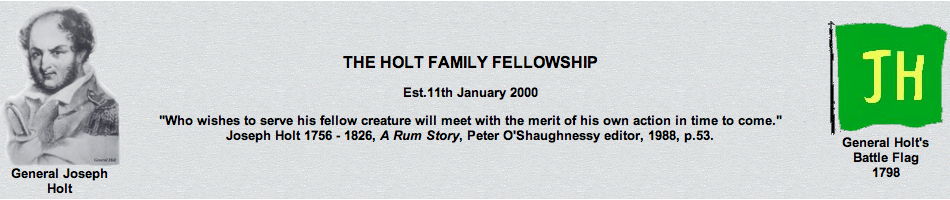
Holt Family Fellowship Flag General Joseph Holt

THE HOLT FAMILY FELLOWSHIP

Est.11th January 2000

"Who wishes to serve his fellow creature will meet with the merit of his own action in time to come."
Joseph Holt 1756 - 1826, A Rum Story, Peter O'Shaughnessy editor, 1988, p.53.


General Joseph Holt's Notice Board

This website is a work in progress and as such is subject to alterations when information comes to hand which adds to or corrects our articles.
ALL ARTICLES APPEARING ON THE, 'www.joseph-holt.org', WEBSITE ARE SUBJECT TO COPYRIGHT.
The moral rights of the writers who participate on our website must be respected. All contributions copied from this website are to be fully identified as the writer's work and not be altered.
The information which appears on our website is freely available. It requires acknowledgement in publications, theses and in lectures.

.
The Holt Family Fellowship was created in January 2000 by Joseph's descendants voting at the bicentennial celebrations of his and his family's 11th January 1800 arrival in NSW. It was held on portion of his former farm, Mt Hester, at Carlingford in Western Sydney, as located by Peter O'Shaughnessy (op. cit.). This portion is included in the park now known as Lake Parramatta Reserve which contains his "Rocks of Jerusalem" where he illicitly distilled his peach brandy. (Looking for Joseph, Pamela Goesch, 2008)

On the 19th January 2007, The General's Chat Room was established, originally for General Joseph Holt's descendants. Due to unexpected demand, The United Irish Researchers' Chat, was added on the 28th January 2007 to provide a separate forum for all descendants of The Society of United Irishmen throughout the world. In 2008, it helped join the Harmon/Harman family descendants formerly unknown to each other and residing in the USA and Australia. Last year, it helped join the Ausralian descendants of Morgan Power, Joseph's close, fellow "cattle doctor" (veterinarian) friend, from the village of Derrylossery near Roundwood and Joseph's farm at Mullinaveigue.

Morgan purchased sheep from an itinerant 'sheep jobber' which turned out to be stolen. Amongst his other duties, Joseph was a Co. Wicklow barony constable and was familiar with the available legal representatives. He employed two Dublin barristers to defend Morgan. Unfortunately, Morgan was convicted and transported to Botany Bay in 1796. General Joseph Holt arrived in Port Jackson four years later, following his arranged surrender to Lord Powerscourt IV in his Co. Wicklow demesne of 'Powerscourt' on the 11th November 1798 as The Society of United Irishmen's Leinster General for the east of Ireland. Possibly through his friendship with Major Abbott, he was able to have Morgan appointed as superintendent of the Government Farm at Toongabbie which supplied food produced by convict labour to the Government Stores to help feed the penal colony.

*******************************************************************************************************************************************

Governor Phillip's Hottentot cattle had escaped in June 1788 from the poor pasture of what is now Edgecliffe, having been moved there by the inexperienced convict Cockney herdsman from the much lusher, eaten out Farm Cove pasture adjoining Cattle (Bennelong) Point where the cattle had been landed and the Sydney Opera House now stands. (A History of the Forbidden Land, L.R. Fowler, F.B. Knox and S. den Hertog, 1988). Working animals were scarce. Devoid of bullocks with which to pull the farm implements in the penal colony, the convicts, by necessity, had to take their place. Even the mare assigned as a pack-horse by Governor Philip Gidley King to Sir Joseph Banks' appointed specimen collector, George Caley, was demanded for the army by Major Robert Ross. King had returned in the Speedy to New South Wales on November 26 1799 with a dormant commission to replace Governor John Hunter. He had been accompanied on board by the military engineer who later erected Nelson's Column in London, Lieutenant Luis Francis Barrallier, and George Caley. He protected his friend's mare from Lieutenant Governor Major Ross's demands.

King was frustrated in 1801 by Major Ross's strict adherence to the Duke of York's military orders stopping him from appointing Lt. Luis Barrallier as his aide-de-camp. To get around this objection, the naval governor appointed him, "Ambassador to the King of the Mountains", which allowed Barrallier to explore the Southern Blue Mountains. Luis went out on two long major expeditions and was finally blocked by the Kanangra Walls. His diary records, in French, the first observation by an European of the making and use of the boomerang by the Gundungurra natives. It was not used by the Sydney tribes.

In 1809 the then Lieutenant Governor of Van Diemens' Land, Lieutenant General Colonel Paterson, as the senior officer, had to reluctantly leave it to assume control of the political New South Wales on the 10th January, as ordered by Major George Johnston, following the deposing of Governor William Bligh by the NSW Corps on the 26th January 1808. The NSW military clique then made another attempt to possess Caley's mare. The request was denied by the Lieutenant Governor who had published his, Narrative of Four Journeys into the Country of the Hottentots and Caffraria, in 1780. It was dedicated to Sir Joseph Banks. Paterson's collecting expeditions for Sir Joseph Banks in South Africa had already earned him his Fellowship of The Royal Society of which Banks was President. (ADB, Section Editor, A.G.L. Shaw, 1967). He recognised the importance of Caley's work. Governor King, who also became a Fellow of The Royal Society, had previously granted George Caley an area for a Botanic Gardens in the grounds of Government House at Rose Hill (Parramatta), established in November 1788 by Governor Arthur Phillip.

Paterson and Caley collected together for Sir Joseph Banks and to establish the Botanic Gardens. The sample collections of King and Paterson helped maintain their active Society membership. The combined three collections sent to The Royal Society included New Holland's unique seeds, pressed and dried plants, and the skinned, salted and dried samples of previously unknown animals and birds. Most of George Caley's original botany samples were returned from England and are now held in The Sydney Royal Botanic Garden's Herbarium. George Caley went on to later establish a botanic gardens in the British West Indian Island of St Vincent which was later transferred to The Botanic Gardens in Port of Spain, Trinidad. Its design is reminiscent of The Royal Botanic Gardens in Sydney but with an indigenous Carribbean flavour.

* * * * * * * * * * * * * * * * * * * * * * * * * * * * * * * * * * * * * * * * * * * * * * * * * * * * * * * * * * * * * * * * * * * * * * * * * * * * * * * * * * * * * * * * * * * * *

To further 1791/99 United Irish family research and as an aid to hopefully clarify this historic period, the Fellowship added The Ascendancy & Yeomanry Researchers' Chat in 2009. We hope that we now provide a total resource for descendant researchers of Ireland's insurgency period to exchange information. It is envisaged that our three free chat rooms will help reduce the effect of at least 219 years of the Church of Ireland and Roman Catholic Churches' opposing Ascendancy propaganda against the Society of United Irishmen movement. The similarly oppressed, and as with the majority of Roman Catholics, disenfranchised members of the Presbyterian Church, had combined with the concerned members of these two churches to form The Society of United Irishmen's army in an effort to win freedom in Ireland for themselves and their fellow Irishmen and women with democratic self-government. The Church of Ireland participants such as Theobald Wolfe Tone and Sir Edward Fitzgerald led the rebellion with other Protestant notables.
The Society of United Irishmen leaders had mainly attended French universities, where they had come under the twin influences of Gilbert du Motier Marquis de Lafayette and another founding father of both The French Republic, and what has become The United States of America; the Englishman, Thomas Paine, whose books, The Rights of Man, 1791 and The Age of Reason, 1793, still influence the world today. It was General Lafayette who encouraged them to take part in the battles for American independence. Their success there persuaded them that it was now time to achieve independence from Britain for Ireland, whose society was still being fragmented under the effect of the pernicious Penal Laws.

"Historians disagree over whether the Penal Laws were a tool of political as opposed to religious repression. Some argue (for instance Eamonn O Ciardha) that they were intended to make Catholics in Ireland powerless and to place landed and political power in Ireland in the hands of an English Anglican settler class. Others (for instance Sean Connolly) argue that it was intended to convert the Irish en masse to the Protestant faith and that it should be likened to the Irish Government's efforts to revive the Irish language since Irish independence." [www.statemaster.com/encyclopedia/Penal-Laws-(Ireland)].

The Society of United Irishmen commenced their efforts for Irish freedom and independence peacefully in parliament. Their failure there saw The Yeomanry Bill subsequently presented in 1796 by the English Whig's Lord Camden, as the Lord-Lieutenant of Ireland, in preparation for the obviously inevitable looming confrontation with The Society of United Irishmen.

We look forward to descendant researchers and others progressing the world's 1798 Irish insurgency knowledge by using our three free chat rooms, The General's Chat Room, The United Researchers' Chat and The Ascendancy and Yeomen's Researchers' Chat in their quest to advance their respective families' knowledge.

Until recently, the dearth of General Joseph Holt's active participating descendants in our protected chat rooms since 2007 has been a puzzling factor, particularly for those who wish to advance the Holt family's research internationally. The participation last year of Gary Holt, the fifth generation compiler of, Descendants of General Joseph Holt, was most welcome. His involvement should encourage those hesitant Joseph Holt family researchers to participate in 2010 and beyond to further our family research through using The General's Chat Room. The current research on Joseph's siblings being carried out in this chat room by Carole Parkes and June Gillespie (England), Bernadette Holt (Ireland), David Holt and Jann (Australia) is most stimulating. It is hoped that The United Irish and Ascendancy researchers will also be encouraged to emulate their helpful style in The United Irish Chat and Ascendancy & Yeomen's Chat. It is suspected that Joseph's brother, Joshua, is buried in the United States of America. It is encouraging that Holt family history researchers in several countries are currently using The Generals' Chat Room as a tool to build and further everybody's family knowledge.

We would welcome knowledge of the birth, marriage and burial dates of Joseph's siblings. In 2006, the late Sean 'Sonny' Holt helped our Joseph Holt's 250th Birthday tourists by kindly clearing the briars and blackthorns from Holt graves in the ruined Church of Ireland Church at Castlemacadam where Joseph's parents and several of his relatives are buried. The family originated from former O'Toole land at nearby Redcross. (pers. comment Sean 'Sonny' Holt as gained through the oral history of his grandfather). Known as "planters", the land was granted to them in the Elizabethan plantation period as led by Sir Walter Raleigh. A list of these Holt gravesites would give us the historical facts upon which to base our continual research. Further lists of such sites in other countries through researchers' participation would help complete our families' honorary research to achieve a complete Descendants of Ballydonnel/Ballydaniel Family Tree and then hopefully an extended one to include the Elizabethan Holt's of Redcross to complete the Ireland 'Plantation' connection to England.

Similar to the International GenealogicaI Index, the information contained on our website is freely available. It requires acknowledgement in lectures, theses and publications.

On March 26, 2009, Brian Albanese, of the University of Connecticut, sought help through The General's Chat Room in regard to his ancestor John Joseph Holt whose, "eldest son, John Joseph Holt ,Jr., was born on November 5'th around the year 1897." Brian with his parents are currently researching for more specific information to provide our researchers. Typically, Bernadette Holt has supplied them with further information in The General's Chat Room already.

Further participation from the USA would be most welcome and lay the foundation for our increased knowledge of the Holt family's international migration. It is hoped that with all the descendants of Joseph's siblings joining in, we will be able to progress the knowledge of John Holt Snr's family of Ballydonnell (Ballydaniel) for posterity.


**********************************************************************************************************************************************

THE REASONS FOR THE FORMATION OF THE HOLT FAMILY FELLOWSHIP AND ITS MEMBERSHIP EXTENSION TO INCLUDE GENERAL JOSEPH HOLT'S UNITED IRISH SIBLINGS AND THUS ALL DESCENDANTS OF JOHN HOLT SNR. OF BALLYDONNELL (BALLYDANIEL) - THE AUSTRALIAN SEPT FROM THE SONS OF GENERAL JOSEPH HOLT OF MULLINAVEIGUE - AND SUMMARY OF HIS AND OTHERS' UNITED IRISH ARMY ACTIVITIES INCLUDING THE RELIGIOUS AND POLITICAL HISTORY MANIPULATION SINCE 1798/99.

The Holt Family Fellowship knew at its founding, that three of Joseph's siblings, namely: John, William, and Johnathon were implicated in the United Irish Insurgency of 1798. During the bicentennial 'Rebellion' year of 1998 The Society of Australian Genealogists' tour of Ireland was led by Dr Richard Reid and our Australian patron, Dr Perry McIntyre. A John Mernagh descendant, Peter Mayberry, discovered amongst his ancestor's papers filed at the Irish National Archives, Dublin, the revealing 1798 summation written from his spies' reports by the Rathdrum magistrate, Captain Thomas King on the United Irish activities of John, William and Joseph Holt. Further research by Dr Ruan O'Donnell for his books, Robert Emmet and the Rebellion of 1798 and Robert Emmet and the Rising of 1803 also confirmed the additional involvement of Thomas and his subsequent support of Robert Emmet who he sheltered on his farm in July 1801. The Fellowship learnt of this from Dr Ruan O'Donnell during its General Joseph Holt's 250th Birthday Tour in 2006.

Following emailed discussions with Ruan in 2007, who had proof of their involvement with The Society of United Irishmen, The Holt Family Fellowship then widened its honorary membership to include all descendants of Joseph's siblings, the children of John Holt Snr. of Ballydonnell (Ballydaniell): John, Thomas, William, Joshua, Mary and Johnathon. William was imprisoned for a short time. Joseph arranged his release. Unfortunately, Johnathon, was killed leading a cavalry charge at Greenane Bridge, Co. Wicklow, during October 1798 while deputising for the bed-ridden Joseph who forever blamed himself for the death of his 21 years' old brother. It is obvious, from his memoirs, that like the French Directory and thus General Napper Tandy, Joseph was unaware of the defeat of General Humbert's French expeditionary force, with its United Irish volunteers on September 8 in Ballinamuck, Co. Mayo. (Memoirs of Joseph Holt, General of The Irish Rebels, Vol I, T.Crofton Croker, editor, 1838; Rebellion in Wicklow General Joseph Holt's Personal Account of 1798, Peter O'Shaughnessy, editor, 1998, Ireland 1798 The Battles by Art Kavanagh,1998). The defeated French were offered the battle courtesies of the period and sent to England as prisoners-of-war, from where they were later repatriated to France.

Lord Camden's Belfast proclamation of The Insurrection Act of 1796, when he was the Lord Lieutenant of Ireland (1795/98), had removed any possible legal chance for the United Irishmen's army to be recognised and extended such military graces. It provided the legal foundation for the coming War of Terror under General Gerard Lake.

The day before the Battle of Vinegar Hill on June 21, 1798, the military-trained Colonel Joseph Holt had condemned the static battle plans of the Wexford leaders as pushed by the famously huge, whip-carrying, charismatic, excommunicated Father Mogue Kearns. Joseph forecast their coming defeat. He kept his Wicklow army in reserve in an effort to save as many lives as possible from the disaster he was expecting. On June 19, following the Battle of New Ross, the excommunicated General Father Philip Roche was elected to replace Bagenal Harvey as Commander-in-Chief. The above decisive meeting was held the following day. The new commander regrettably did not yet have the power to accept his Wicklow Colonel's advice and intercede on military grounds against the mainly gentry, and mainly military-untrained, County Wexford officer majority before the Battle of Vinegar Hill the next day.

Not officially recognised by the British, the Wexford army leaders and their men, with their accompanying women and children, were routed on Vinegar Hill following a fierce, prolonged cannonade. They paid a fearful price for ignoring the military advice of the Wicklow Colonel, Joseph Holt, who had continued his military training with Arklow's Volunteer Corp. Their defeat occurred on the 21st June 1798. The thick fog, which had initially helped the survivors' escape to the sanctuary of Joseph Holt's Wicklow army in Glenmalure, caused the separation from the main escaping body of the United Irish remnant led by the excommunicated Father John Murphy, from Boolavogue. He and the excommunicated Father Michael Murphy of Ballycanew had previously led their congregations to victory in the Battle of Oulart Hill against the North Cork Militia on May 27. It was this militia who introduced the torture of pitch-capping to County Wexford. (History of the Insurrection of the County of Wexford,A.D. 1798, Edward Hay, 1803;History of the Irish Rebellion of 1798, Philip Harwood, 1844).

Fathers John and Michael Murphy were excommunicated by Dr John Thomas Troy, Archbishop of Dublin, along with the other insurgency embroiled priests, because of their participation. It was against the Vatican directives. The church feared that their involvement would hazard its position in Ireland even further with its already diminishing Ascendancy power. Archbishop Troy was placed in an invidious position between the Vatican's directives, his young able priests and their resentful parishioners. Similar to Joseph Holt's stated reason for joining the United Irishmen with the burning of his Mullinaveigue house by the Fermanagh Militia, their tiny chapels had been burnt down by the North Cork Militia. To protect their parishioners, they had earlier supported the Dublin Castle directive for them to hand in their guns. The priests' indignation at the Ascendancy treachery through their militia helped them to successfully lead their parishioners against this notorious force.

Lost in the fog, Father John Murphy's remnant army was pursued and defeated at Kilcumney on June 26 by Brigadier General, Sir Charles Asgill's army. (Kilcumney '98 Its Origins, Aftermath & Legacy, Mick Kinsella, Edward N. Moran & Conor Murphy, 1998). On July1, a sympathetic Protestant farmer hid the hunted priest on his farm near Tullow, Co. Carlow. On July 2, a Roman Catholic farmer followed Archbishop Troy's condemning lead by accepting the offered reward for betraying his priest. (op.cit., Edward Hay, 1803; op.cit., Philip Harwood, 1844). His action, when coupled with the Protestant farmer's, illustrates the fragile loyalties and confusion of the time.

Father John Murphy and his body guard, led by James Gallagher, were captured. "They were brought before a military tribunal and charged with committing treason against the British crown. This was done even though Father Murphy nor any of the men who fought with him had ever served in the British army nor had any of them ever sworn an oath of allegiance to the British monarch." (http:www.aohplymouth.com/Division%96209%20History.htm). Father Murphy was flogged, hung and his body burnt in a barrel of tar by the yeomen. His head was placed on a pike and displayed at the town gate as a warning to all. (op.cit., Edward Hay, 1803, Ireland 1798 The Battles, Art Kavanagh, 1998). His escaping exhausted troops, some asleep at the roadside, had been already slaughtered along with the adjacent villagers to the Kilcumney Hill battlefield.

A similar fate was awaiting General Joseph Holt three months later, when he and his nine men were resting in Quinn's house at Glenbride. Quinn returned from Blackditches without the gallon of spirits as requested by Joseph for his men. Joseph had paid him for it. Quinn returned the money. He believed that he was about to reap the Three Hundred Pounds reward in gold offered for Joseph's capture. Joseph posted his sentries, then he and the remainder of his men went to bed. Joseph's subsequent dream of his bed being on fire awoke him in time for most of them to escape the surrounding British detachment.

For the escape, Joseph organised his men into pairs with loaded pistols and muskets. When the first two, the Englishman, Joseph Begly, and James Donohoe of County Waterford, were shot dead, Joseph immediately led Maurice Macoon into the dark night with pistol and sword in hand. Joseph shot a sergeant to enable their escape. Macoon received a ball in his shoulder. General Joseph Holt's feather plume on his French officer's hat, as part of his uniform for the expected French invasion, was shot in three places!

Two of Joseph's men were killed, three were wounded and one captured. The two sergeants leading the surrounding Scottish troops were both killed, along with four privates and one wounded. When further troops arrived, they mistook the sounds of movement within the darkened house for Joseph and his men. Three of Quinn's family and his servant boy were killed when a fusillade of shots blasted through the doorway. Quinn had already left to collect his reward in Glenmacnass certain that Joseph and his men could not escape. He had silently led the detachment around Joseph's sentries to their positions. (op.cit. Vol I, T. Crofton Croker, 1836; op.cit. Peter O'Shaughnessy, 1998).

Obviously shell-shocked from the carnage at Vinegar Hill, The Society of United Irishmen's Leinster field General, Edward Roche, was condemned by his officers and men for failing to take the opportunity to engage a numerically inferior enemy following the harrowing defeat at Vinegar Hill. Edward subsequently invited the vociferous Joseph to be, "commander the following day" (op.cit. P. O'Shaughnessy, 1998) and to plan the battle. The result was the successful Battle of Ballyellis on the 30th June 1798, near Carnew. Despite Edward taking part in the thickest part of the fighting, his brother, the excommunicated General Father Philip Roche as the recently elected Commander-in-Chief, then confirmed Joseph's appointment as the new Leinster General and field commander. He possibly had been instructed by the Dublin Directory to have Joseph supersede his brother following the success of Joseph's tactics which had led to the United Irish army inflicting the major defeat at Ballyellis upon the British forces.

General Humbert's combined force led by his experienced French troops engaged the enemy at Killala, County Mayo, on August 27. They quickly won The Battles of Castlebar, Collooney, Granard and Wilson's Hospital. Lord Cornwallis arrived with his army at Carrick-on Shannon on September 7, to block Humbert's path of escape from the pursuing General Lake's army. The combined British armies numbered 17,000. Humbert's combined army numbered 1,000. The main French fleet was blockaded in the Mediterranean by Horatio Nelson's fleet. (It was defeated at The Battle of Trafalgar on October 21, 1805.) It was necessary for Humbert's fleet to return to France for more troops and further supplies. The Battle of Ballinamuck on September 8, before their return, resulted in the defeat of the combined French and United Irish armies within half an hour. It brought General Lake's ' War of Terror' to the west coast. His army carried out their 'mopping up' of General Humbert's United Irish complementary force despite their surrender (op.cit., Art Kavanagh) as authorised by Lord Camden's Insurrection Act of 1796.

The slaughtering of the Fretilin forces with civilians in East Timor by the Indonesian army, conducted under martial law, is a recent reminder of the legal savagery existing in 1798. The current investigation of the government-approved killing and razing of the Northern Tamil Hindu Sri Lankan villages and villagers is a more recent example, despite the Sri Lankan parliament and army professing their belief in that country's Budhist faith, with its important temple in Kandy housing Buddha's tooth, and the requirement not to kill a living creature, whether human, insect, bird or animal.

Although Joseph followed his win at Ballyellis, with the further successes of the Battles of The Hills of Glenmalure and of Aughrim, once news of General Humbert's defeat reached the ill General Joseph Holt in Co. Wicklow, he would have realised that his brother's death had been in vain, as it had occurred well after the west coast defeat of the combined French and United Irish armies by the British forces. He was now devoid of any practical help from France.

A French force of 250 reinforcements commanded by General Napper Tandy who sailed on the Anacreon, had landed at Rutland Island, Co. Donegal on September 16, expecting General Humbert's landing to have been in County Donegal as planned by the French Directory Generals. The prevailing winds had decided the disembarking issue for General Humbert. He expected that General Tandy's troops would arrive in time. Once again, as in Bantry Bay, the weather had saved Britain. On learning of General Humbert's defeat in County Mayo, General Tandy's army re-embarked and left, taking their important supplies of arms and gunpowder for the United Irishmen with them (op.cit., Art Kavanagh). In an effort to avoid the British navy, they sailed with their now despairing, drunk Irish General to the Orkneys, Bergen in Norway, thence The Free and Hanseatic League City of Hamburg. Their arrival there sparked an international problem with Britain for this powerful state city.

When news of this latest military debacle against the combined British forces reached Joseph, the original "Wicklow Chieftain", he dispersed his men in an effort to prevent them, their families and villagers from suffering the systematic savage butchery under General Lake's command that had followed the previous defeats of the United Irishmen's forces. His memoirs and subsequent research reveal that, from the time of his appointment as General, he acted closely with the Dublin Directory and perhaps had done so previously as Captain then Colonel. His friendship with Richard Dry, a member of the United Irishmen's Dublin Directory and clothier with his brother, Thomas, from The Liberties in South Dublin could have resulted from this. However, with the Dry family being a renowned family of Dublin dyers, they possibly had an earlier association with Joseph as members of the Defenders agricultural movement when he was Deputy Alnager at Rathdrum, Co. Wicklow, which required him to judge and stamp the quality of the dyed, woven, woollen 'flannel' collected on his farm rounds. He had an office in the Rathdrum Flannel House for this purpose. A Church of Ireland Protestant like the Drys, it is likely that, Joseph was in sympathy with this mainly Roman Catholic tenant farmer political movement, but unlike them did not join it. This would account for his subsequent proven regard for members of this Christian denomination.

As with other members, the Dry brothers had continued their original 'Defender' resistance to the Penal Laws by becoming members of the 'Philanthropic Society', the cover name used by The Society of United Irishmen's Dublin Directory for their meetings, some of which it is known that Joseph Holt attended as General. His real and imagined presence in Dublin was headlined by the newspapers of the day. Richard was arrested at Roscommon on February 1797. Thomas was arrested in Belfast on April 1797. Both arrests were obviously as a result of spies' reports. Richard escaped and was later rearrested on May 1798 in Cork. This was in time for him to sail on August 24 1799 from the Cobh of Cork with Joseph to New South Wales aboard the, Minerva. ( 1798 A Bicentenary Perspective, Thomas Bartlett, David Dickson, Daire Keogh, Kevin Whelan, editors; op. cit., Peter O'Shaughnessy).

The defeat of the combined French and United Irish military forces in Ballinamuck under the French General Humbert after their previous successes in The Battles of Castlebar, Collooney, Granard and Wilson's Hospital, was followed by a bloody aftermath. It is conceivable that the ill and wounded Joseph was then directed by the Dublin Directory to accept the need to politically surrender in an effort to put a stop to the ever-increasing butchery on both sides. It was arranged for him to do so to Lord Powerscourt IV on 11 o'clock on November 11, 1798 at his Co. Wicklow demesne of Powerscourt. A 121 years later, King George V was to proclaim this time and this day as Remembrance Day for the fallen of the British and British Empire troops of World War I.

Joseph's memoirs reveal his constant consideration of others, particularly his men and family; although he could be ruthless when the occasion demanded. Lawlessness was rife, fuelled by religious bigotry. Gangs of "banditti" were using both the General's and The Society of United Irishmen's name to carry out their nefarious and opportunistic crimes against their fellow Irishmen. It was time to cease the senseless bloodshed.

* * * * * * * * * * * * * * * * * * * * * * * * * * * * * * * * * * * * * * * * * * * * * * * * * * * * * * * * * * * * * * * * * * * * * * * * * * * * * * * * * * * * * * *

When Joseph Holt completed his agricultural survey of the New (Derwent) River Valley in 1805 for Lieutenant Governot David Collins, he wanted to appoint him superintendent of Van Diemen's Land's infant agriculture (About Joseph). However, having spent nearly seven years away from Ireland, Joseph and Hester Holt longed to return there and to their daughter, Mary Anne (Marianne) Shaw nee Holt in Co. Wicklow. She had been left under the protection of the Huguenot banker, Peter Latouche's wife, Elizabeth as her guardian. (op. cit., T.Crofton Croker, 1836; op.cit. Peter O'Shaughnessy, 1998; op.cit. Ruan O'Donnell, 1998; The La Touche Family in Ireland, Michael McGinley, 2004). Joseph suggested that his United Irish Dublin Directory friend at Port Dalrymple (Launceston), Richard Dry, take his place (About Joseph). Richard had been included in the convict party to Port Dalrymple which accompanied Lieutenant Governor William Paterson in 1804.

In 1808 the 'Rum Corps' overthrew Governor Bligh in New South Wales. As the senior officer, Paterson was recalled to Sydney to take command, leaving Lieutenant General David Collins as the sole Van Diemen's Land commander. He was then able to carry out Joseph Holt's 1805 departing recommendation by appointing Richard Dry deputy agricultural superintendent at Port Dalrymple (Launceston). He was granted 30,000 acres near the port. He named it, Elphin Farm having come from Elphin, Co. Roscommon (pers. comm. Dr Ruan O'Donnell). His son, Sir Richard Dry, became Tasmania's first native born Premier (1866 - 1869), after being one of the 'Patriotic Six' leaders against transportation to Tasmania. (The Life and Times of Sir Richard Dry, A.D. Hope, 1951). "The last transport to Tasmania was dispatched towards the end of 1852." (Australian Encyclopaedia, 1958, Editor-in-Chief, Alec H. Chisholm - Convicts and Transportation A.G.L. Shaw). Sir Richard built his homestead, Quamby, on the additional 500 acres granted to his father by Governor Macquarie in 1811. In 2004 Quamby was a beautiful golf course outside Launceston. The remainder supported an impressive mixed-blood beef cattle herd. His refurbished homestead was sold that year, on the retirement of a local pharmacist who, together with her husband, had spent their years faithfully restoring it.

Richard's other son, William, "was the first Tasmanian to receive holy orders", (www.ballaratweb.net/suec/tasdrys). Sir Richard and other members of the Dry family are buried at the nearby St Mary's Church, Hagley, which he had had built and endowed. It is interesting from The Holt Family Fellowship point of view to contemplate what might have been if Joseph Holt had accepted Lieutenant Governor Collins' offer.

Unconfirmed information suggests that a sibling of Joseph's, Joshua, moved to Liverpool and possibly to the USA. The latter could be the reason why Joseph's younger son, Joseph Harrison Holt, sailed there with his family aboard the John Jay to arrive on September 16, 1836, before returning to Ireland via Liverpool. Liverpool was the port of arrival and embarkation for Irish travellers and others for sailing to and from the rest of the world. Joseph Holt and party arrived there in the Venerable during their return journey to Ireland on January 18, 1814, from Rio de Janeiro. He had embarked on October 21, 1813, with Hester, Joseph Harrison Holt and his man servant, John Byrne. The Isabella had been shipwrecked on Eagle (Speedwell) Island in the Falkland Islands on February 8, 1813, after it had sailed from Port Jackson on December 4, 1812. He and his companions were rescued by the Nannina on April 4. The Port of Liverpool has remained a normal commercial sea-going route to North America and to the world, as with Southampton.

The mystery of Joseph Harrison Holt's New York adventure still needs to be solved. It was discovered through the original research of a descendant of Joseph's sibling, Joshua Holt, Carol Parkes of the United Kingdom, and forwarded to Gary Holt in 2004 during his research for his book, Descendants of General Joseph Holt. We do not know why or how the family returned to Ireland prior to Joseph H. sailing with them to rejoin Joshua in Sydney. They left from Liverpool in steerage class on the Superb. The diary of an enthusiastic cabin class passenger, Thomas Sutcliffe Mort, reveals that it was well named. They arrived in Port Jackson, New South Wales, on the 25th February 1838 and initially stayed with Joshua and family. (op.cit., P. Goesch, 2008; also refer to About Us).
**************************************************************************************************************************

Long before the Y2000 establishment of The Holt Family Fellowship in Australia, Sean 'Sonny' Holt held a 1978 Holt family reunion in Aughrim during the Holt's Way naming celebrations in Wicklow which he and others had done so much to promote. During the Society of Australian Genealogist's 1998 tour, the party led by Dr Perry McIntyre, made a surprise visit to Mullinaveigue and took photos of the fifth generation, Lionel Fowler, beside the memorial which the Roundwood Historical Society and Wicklow County Council had recently erected adjacent to the rock wall of Joseph's former Mullinaveigue farm. Sean 'Sonny' Holt was also involved with this project and had earlier unveiled it in front of dignitaries, family and friends. Charlie Holt led a touring group of Holt family from the USA for the occasion. Despite Sonny's protests, the word, "Descendant", was inscribed on the memorial stone. He was quite embarrassed by this and had ground it off before the arrival of our Holt Family Fellowship members from Australia in 2006.

At the close of the 1998 SAG tour, and with no knowledge of Sonny's address apart from him living in Aughrim, Lionel searched for and found Sonny and Annie Holt, having learnt of their years of industrious support for the recognition of General Holt's role during the United Irishmen's insurgency and his place in Irish history. During his drive to Aughrim, Lionel was surprised by the coincidence to hear Annie on his car's radio fiercely arguing for General Joseph Holt's place in Ireland's history to be recognised by the bicentennial committee. Upon his arrival, they were all shocked to find that such large Irish and Australian Holt family septs were unknown to each other, hence the lack of knowledge in Australia of General Joseph Holt's memorial unveiling ceremony. This was possibly due to the destruction of incriminating correspondence by United Irishmen's families during Lord Camden's, 'War of Terror', carried out by General Lake. It seemed that the Australian, Irish and USA historians had no real accurate knowledge of, or interest in, the life of General Joseph Holt's only two grandsons, Joshua and Joseph Harrison Holt, or their descendants. His grandsons had lived in and were buried in New South Wales.

As a result, there were many claimants of direct descent from General Joseph Holt in countries other than Australia, apparently resulting from the poor scholarship of historians. One has only to read the original entry on Joseph Holt by G.C. Bolton, a member of the National Committee for the 1966 edition of the, Australian Dictionary of Biography, to realise this. His account held up and confused Australian descendant researchers for years as they tried to follow the incorrect family leads that he had given. None the least, being his bewildering omission of Joseph Harrison Holt and the inclusion of a "John"! Fortunately, our Irish patron, Dr Ruan O'Donnell, has upgraded this entry for the online edition.

The Sydney born, Elizabeth Fowler nee Holt, had maintained the family graves at St Thomas's Church of England Church's burial grounds at Mulgoa, NSW, following the death of her father, Joseph Harrison Holt, on the 13th July 1884 and subsequent death of her mother, Elizabeth, on the 20th March 1885, both of whom were buried there. This family responsibility has been carried on by many of her descendants over the subsequent years. The descendants of his elder brother, Joshua Holt, have done the same with the family vault which Joshua had had built in the Camperdown Cemetery when his wife Elizabeth Holt, nee Bray, predeceased him on the 27th April 1858. He died on the 11th July 1860 and was buried with her. Several of their descendants' graves are nearby. The shocked realisation in 1998 of the lack of awareness in Ireland of Joseph's true descendants in Australia led to the creation of The Holt Family Fellowship in 2000 by Joshua's and Joseph Harrison Holt's direct descendants' families voting to establish it.

Baptism and burial certificates of the Ireland born children of both Joseph Harrison Holt and of his sister, Mary Anne Shaw, nee Holt, have since been found in the records of The Monkstown Parish Church, Dublin. (Looking for Joseph, P. Goesch, 2008). Family researchers have yet to further the Shaw family history in Ireland past this point, although Bernadette Holt of Sligo has unearthed and forwarded some interesting leads in The General's Chat Room. Carole Parkes added Pam Goesch's Shaw family information there on 31.3.10.

Charlie Holt and his family had been keeping General Joseph Holt's memory alive in the USA. His son, Terry Holt, continues to organise well-attended family gatherings as advertised on The General's Notice Board in 2007. Two of our inaugural patrons, the late Sonny Holt and his wife, the late Annie Holt, were feted there during their 2002 world tour. This had earlier included Tasmania under the guidance of a Joshua descendant, Diana Hardy Wilson, and in New South Wales, where they stayed with several descendant families.

John and Chris Holt, 5th generation descendants through the Australian born son of Joseph Harrison and Elizabeth Holt, Thomas Holt, arranged a family gathering at the Wallacia Picnic Grounds, NSW, established by John Fowler, the son of of Joseph H's and Elizabeth's first Australian born child, Elizabeth. The party then went on to the St Thomas' Anglican Church in the adjacent village of Mulgoa, to place flowers on the graves of Joseph Harrison Holt, and his second wife, Elizabeth. They also viewed the graves of their Ireland born son, Isaac, Australian born daughter Elizabeth, and her Fowler, Turnbull and Davis descendants. Unfortunately, Annie unexpectedly died after their return to Aughrim later that year. Sean 'Sonny' Holt was laid to rest with her last year. They were irreplaceable losses for the Fellowship.

Sonny revisited the USA in 2004 with his son, Fergus, the Managing Director of Holt Developments. Following that trip, Fergus arranged for his brother, Pascal, to design and have cast General Joseph Holt's 250th birthday plaque. It was unveiled during our 2006 tour by Joseph's descendants, Laurie Hibbard nee Fowler (4th Generation) and Lionel Fowler (5th generation) in the presence of County Wicklow councillors; Sonny, his family members; and our touring party; at the Holt Crescent development in Tinahely built by Holt Developments (Fergus & Sonny). As arranged by them, this group went on to join other dignitaries, family and friends at Lawless's pub in Aughrim to celebrate Joseph Holt's 250th Birthday. Dr Ruan O'Donnell furthered the gathering's knowledge of Joseph's life and times with his address. Sonny and Fergus also arranged for a criac band to give the coach touring party much needed exercise with their previously unknown Irish cousins. (About Us). Everybody present enjoyed an enjoyable night full of bonhomie.

It is hoped that we can establish permanent Holt family bulletin pages from Ireland and the USA this year for their activity information, thus aiding our fraternisation and helping all John Holt Snr's descendants further their valuable research. We need volunteers for such a page and would also like a Holt family member in Ireland to volunteer to be our originating country's correspondent thus internationalising and broadening our active Fellowship.

To learn more about Joseph's interesting and busy time spent in what is now Australia, please visit About Joseph. This feature has been augmented with his Van Diemen's Land agricultural observations, subsequently used without acknowledgement by several historians in the nineteenth and twentieth centuries. His 1805 agricultural survey of the Derwent Valley proved vital and enabled the Lieutenant Governor of Van Diemen's Land, Colonel David Collins, settle the inhabitants of the Norfolk Island Penal Colony upon its closure, hence the City of New Norfolk in Tasmania, the name chosen by its inhabitants which Governor Lachlan Macquarie had named in 1811, Elizabeth, after his wife. . (op.cit., Vol II, T. Crofton Croker, 1838; A Rum Story, Peter O'Shaughnessy, Editor, 1988; Looking for Joseph, Pamela Goesch, 2008).

Matthew Fowler has updated the entry on Joseph Holt in the Wikipedia and provided them with our image of Joseph. He recommends the following three websites to researchers:
http://en.wikipedia.org/wiki/Joseph_Holt_(rebel)
http://en.wikipedia.org/wiki/Irish_Rebellion_of_1798
http://flag.blackened.net/revolt/andrew/1798republicanism.html


David Griffiths of N.Z. has agreed to help our family researchers by allowing his well researched website, Manning, Saul & Wingrove, to be linked to our Fellowship's so as to give our members research access to Hester Holt's "Orangermen" Manning family background and to various other sites, such as the Irish National Archives & RCB. We thank him for his generous gift to aid our family research.


Following David Savage's lead, and with William Power's keen involvement in our chat rooms, a Morgan Power descendant, Arthur Paris, has kindly agreed for our Fellowship's website to be linked to his, http://members.ozemail.com.au/~pari1art/. Morgan was Joseph's close friend. He purchased 26 head of sheep which turned out to be stolen. The sheep dealer disappeared and Morgan was arraigned. As a fellow cattle doctor and farmer, Joseph's positions of bounty hunter, barony sub-constable and deputy alnager placed him in the financial position where he was able to pay the defence legal fees of the Dublin counsellors Guiness and Darley on Morgan's behalf, unfortunately to no avail. See The General's Chat Room. As Morgan was Joseph's close friend, and apparently not an United Irishmen member, the Fellowship has decided to transfer all the Power descendants' chat to The General's Chat Room. Because of demand, The United Irish Researchers' Chat Room had been split off earlier to concentrate the research of the Holt family and United Irish researchers separately. With the subsequent two instances of family research success in the The United Irish Researchers' Chat, we have decided to add, The Ascendancy Researchers' Chat, to answer this specific need. Many families have found that some of their ancestors were opposed to each other during the 1778/79 insurgency period. If demand warrants it, A Yeoman Researchers Chat could also be added to further our understanding of this period.

Our website, www.joseph-holt.org, is maintained and protected by Mal Ellson of www.charlieweb.com.au.

His services are available to those families interested in establishing their own websites, as well as to those University/TAFE undergraduates and postgraduates who might want to establish their own sites to further their research enquiries.


Have a Happy, Healthy and Successful New Year of 2010

Lionel R. Fowler.

The Holt Family Fellowship,
Post Office 3059, Wallacia, NSW 2745, Australia.

Top of Page

Holt Family Fellowship Flag
1798